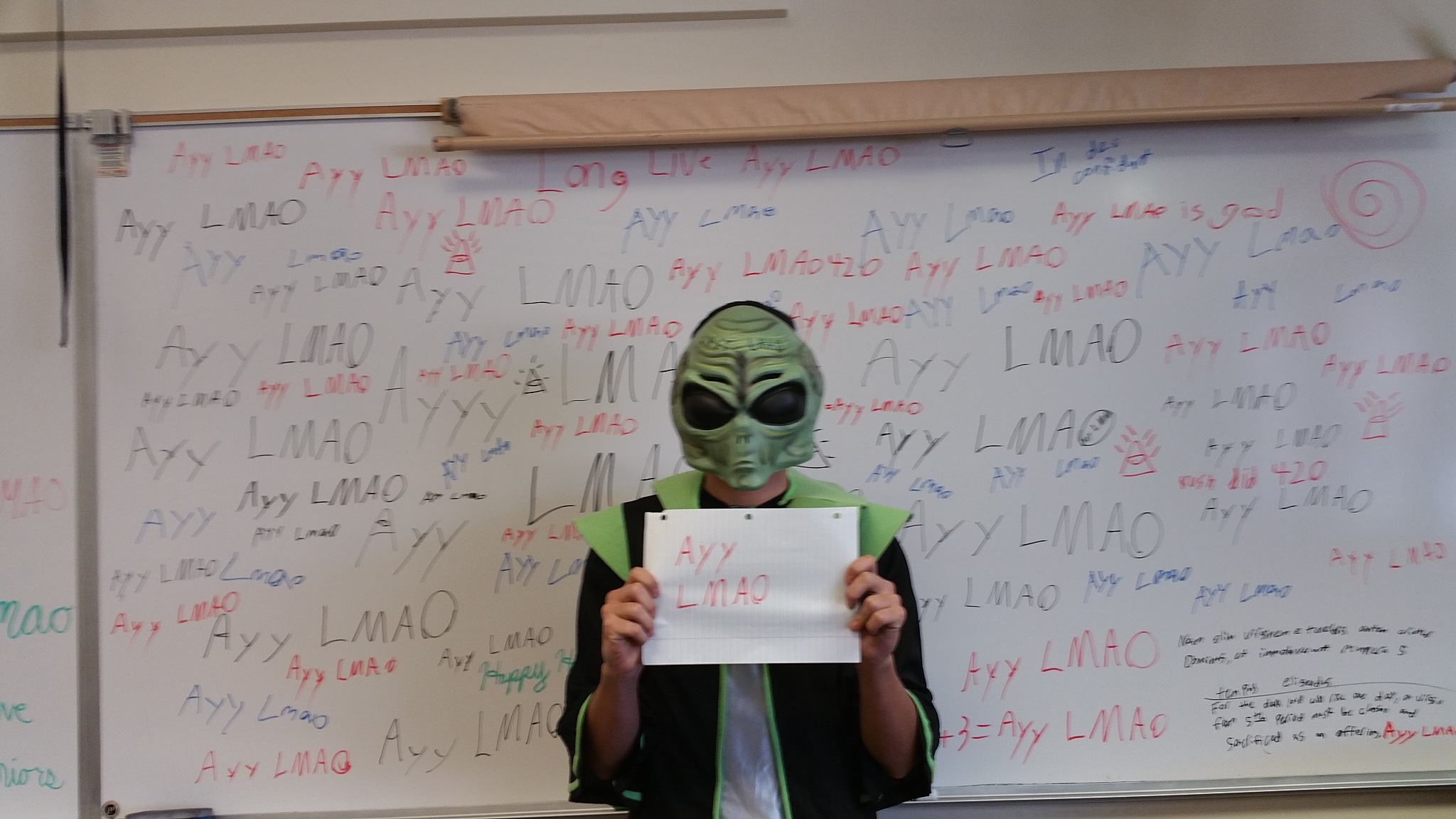
Any idea what Ayy LMAO means?
No?
Have heart teachers – you are not alone!
A few years ago, during an extended family get together of some sort, we somehow we got to talking one morning about music. Everyone in my family likes music, especially my brother and I, but we tend to shy away from discussing our tastes aloud to anyone but ourselves. I think my mother was asking about the kind of music my kids liked, which then flowed into a diatribe about rap music. Now, I’m no hug fan of contemporary rap music, but I do appreciate its place within popular culture, and marvel at it’s hold over young people of all races and ethnicities. I see how it connects young people to experiences and themes they can identify with, just as the music of my youth did for me. In the late 80’s and early 90’s, rap music to me was almost an alien life form, and it took awhile for it to have any effect whatsoever on me. I listened to Public Enemy and was immediately taken aback by the force and fury of the lyrics, and the minimalist sounds in the background that were almost non-musical. I wondered if it was even music. I mean, where was the guitar? Public Enemy described a world that was vastly different from my own, but something I wanted to more about.
I ended up listening to many different artists, until one day my brother had me check out N.W.A. I was completely blown away. Fury had turned to violence, and I struggled with feelings of attraction and revulsion all at the same time. During a poetry unit as a student teacher I would play clean versions of rap songs with the lyrics printed out, so my students could get a sense not only of the density of the imagery, but also of the different ways at which a poem could be delivered to an audience. I was young then, not many years removed from a high school classroom.
I thought of this as my mom went on and on about how terrible rap music is, and how she just didn’t understand how people liked it. After a couple of minutes, I interrupted her and said, “It’s not for you, mom. This music was not made for you.”
It probably came across as rude, but the flavor of what I was trying to say rings true. As the edgy, controversial music of our youth becomes bland and slotted into no-brainer, ready-made Pandora playlists, new forms or new explorations of previous forms flash to life. Our grip on what is hip and trendy begins to slide through our fingers, and we’re left with memory.
Which is how it supposed to be. Some of us hold on to the old stuff like it’s something that defines us, but I think that’s not an accurate description. It defines a time and a place, and an emotion. We can appreciate the new (or what is taken for new) for what it is, but we needn’t worry that we don’t “get it”.
All of this is a very long-winded way of saying that, as teachers, we don’t need to concern ourselves with staying too terribly current. Of course anyone with a passing interest in young people will have a sense of what’s cool and what’s not, but don’t beat yourself up if you happen to miss something. Even as a young teacher, you will get snickered at for being “old”. The separation is important, necessary, and natural. The trick is to be relevant without being trendy, to identify without being referential, and to connect without being, well…connected.
We are good teachers because we care about the people our students are and can be – not about what trend they happen to be trying on at the moment. It’s all Ayy LMAO, anyway.
But what is Ayy LMAO you might ask?
Answer: It’s not for you.
 haveheartteachers